Smart scale review
Hume Body Pod Review 2026: Is This Smart Scale Worth It?
A close look at what the Body Pod is designed to measure, where BIA technology has limits, and how to decide whether its broader tracking experience fits your goals.
Interested in the Hume Body Pod?
Check today’s price, availability, specifications and purchase terms directly with the seller.
Check Current Price & AvailabilityYou will leave Body Metrics Lab and visit the seller's website.The Hume Body Pod is positioned as more than a basic bathroom scale. It pairs weight readings with bioelectrical impedance analysis (BIA) and an app intended to show changes in body composition over time. We reviewed its advertised feature set, the practical limits of consumer BIA, and the questions shoppers should ask before buying. This is an editorial analysis; we do not claim hands-on testing.
Quick verdict
The Body Pod may appeal to people who want a richer trend dashboard than an ordinary scale provides and who are comfortable treating body-composition figures as estimates. Its usefulness depends on consistent measurement habits, app preferences, current pricing, and whether the extra metrics will change how you monitor progress. Anyone needing clinical-grade assessment should speak with a qualified healthcare professional rather than relying on a consumer smart scale.
Hume Body Pod at a glance
What is the Hume Body Pod?
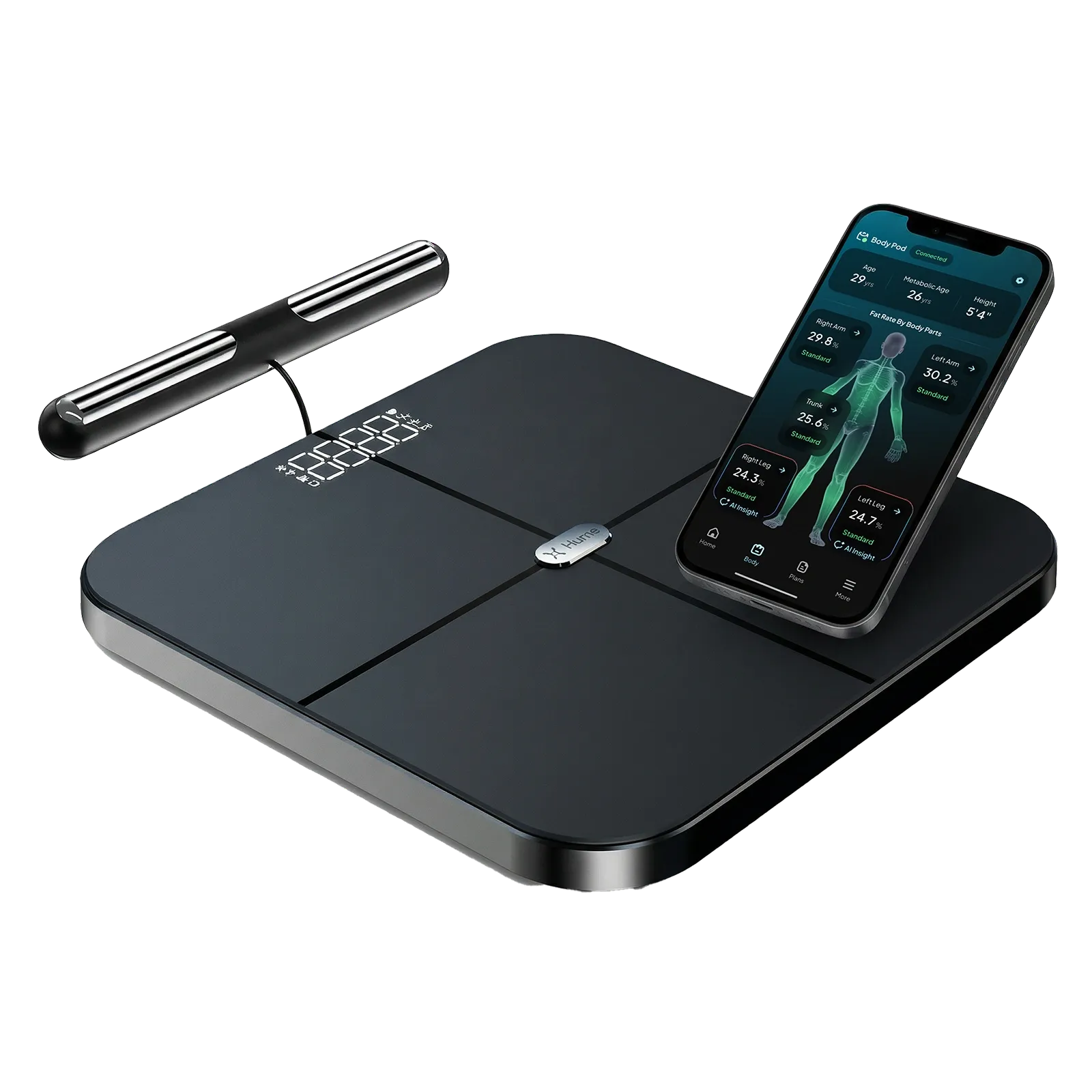
The Body Pod is a connected scale from Hume Health. According to the manufacturer, it combines weight measurement with BIA-derived body-composition estimates and presents results in a companion app. The product is designed for people who want to observe multiple indicators and longer-term patterns, rather than weight alone.
That distinction matters: more displayed metrics do not automatically mean more certainty. Each derived value should be interpreted in the context of the measurement method and normal day-to-day variation.
How BIA smart scales work
BIA devices send a very small electrical current through the body and measure impedance. Algorithms then combine that signal with profile information such as height, age and sex to estimate aspects of body composition. Because the device estimates rather than directly observes tissue, readings can shift with hydration, recent food intake, exercise, skin temperature, time of day and electrode contact.
For home tracking, a consistent routine can make trends more interpretable: use the scale at a similar time, on the same hard surface, with clean bare feet, and under broadly similar hydration and activity conditions. Avoid overreacting to one reading.
Main features
The manufacturer presents the Body Pod as a multi-metric tracking platform. The practical value of that approach is the ability to keep readings in one history and look for direction over weeks or months. Buyers should confirm the current feature list, compatible phones, account requirements, household-user support and any subscription terms on the seller’s website, as software and offers can change.
- Connected weight and body-composition tracking
- App-based history and visualization
- Multiple estimated metrics rather than weight alone
- A design intended for repeated at-home measurements
Body composition metrics
Smart-scale dashboards commonly display estimates such as body fat, lean or muscle-related measures, body water and visceral-fat indicators. Hume Health describes a broader set of measurements for the Body Pod, but labels, calculation methods and availability may change. Treat related outputs as algorithmic estimates—not separate laboratory measurements—and verify the current specifications before purchase.
A large metric count can be motivating for some users and distracting for others. Pick a small number of relevant trends in advance, and consider how you will act on them.
App experience
The app is central to the product proposition: it organizes readings, makes trends easier to see and may offer contextual guidance. Before buying, consider whether you are comfortable creating an account, how data export and deletion work, whether the app supports your phone, and whether any desired features require an ongoing payment. Review the current privacy policy and app-store information because software behavior can change after publication.
Accuracy considerations
“Accuracy” has several meanings. A scale may measure body weight consistently while its body-composition estimates vary more substantially. Consumer BIA results should not be treated as interchangeable with DEXA, clinical assessment or diagnosis. Even when a trend is useful, the absolute figure may differ from another device or method.
For more meaningful comparisons, focus on repeatability under similar conditions. If a number changes sharply, consider hydration, meals, recent training and measurement setup before assuming body tissue changed. People making medical decisions or managing a condition should seek professional guidance.
Potential benefits
- More context than weight alone: estimated composition trends can add another lens to a fitness log.
- Centralized history: an app can reduce manual record keeping and make patterns visible.
- Convenient repetition: home access supports frequent, consistently timed readings.
- Engagement: some users find trend feedback useful for maintaining routines.
Potential drawbacks
- BIA estimates are sensitive to measurement conditions.
- Extra metrics may create false precision or unnecessary attention to daily fluctuations.
- The experience depends on an app, account and phone compatibility.
- Software features, subscription requirements and privacy terms may change.
- A premium connected scale may cost more than a basic scale without being necessary for every user.
Who it may be suitable for
It may be useful for a data-oriented user who enjoys tracking long-term patterns, understands the limits of BIA and will measure under consistent conditions. It may also suit households seeking a connected dashboard, provided current multi-user support and privacy controls meet their needs.
Who may not need it
A basic weight scale may be enough if you want one simple measurement, dislike app-based products, or know that numerous body metrics would add stress rather than useful context. It is also not a substitute for a clinician or an appropriate clinical measurement method.
Hume Body Pod vs. ordinary smart scales
| Consideration | Hume Body Pod positioning | Ordinary smart scale |
|---|---|---|
| Tracking depth | Designed around a broader app dashboard and multiple estimates | Often focuses on weight plus a smaller set of estimates |
| Best fit | Users interested in detailed trends | Users who prioritize simplicity and lower cost |
| Limitations | Both rely on consumer BIA for composition estimates and are affected by measurement conditions | |
| Decision factor | Compare current price, app policies, compatibility, support and the metrics you will actually use | |
Pricing and value
We do not list a fixed price because promotions, bundles, shipping, taxes and subscription terms can change. Use the seller link to check the current total cost and return policy. Value depends less on the number of displayed metrics than on whether you will use the trend history consistently and whether the app’s ongoing terms work for you.
Pros and cons
Pros
- Broad, app-centered tracking concept
- Convenient at-home trend monitoring
- More context than weight alone
- Can encourage consistent record keeping
Cons
- Composition results remain estimates
- Readings can vary with hydration and routine
- Requires comfort with an app and account
- May be more detail or expense than some users need
Final verdict
The Hume Body Pod has a clear audience: people who want a more detailed home-tracking dashboard and can interpret BIA numbers as directional estimates. Its strongest potential benefit is convenient trend organization, not medical certainty. Compare its current terms and total price with simpler alternatives, and decide whether the added data will support a specific habit or decision. If your needs are clinical, use an appropriate healthcare pathway.
View the current seller details
Check current pricing, availability, compatibility and policies before deciding.
Visit Seller WebsiteOpens the seller's website.Frequently asked questions
Is the Hume Body Pod medically accurate?
It is a consumer BIA smart scale, not a medical diagnosis tool. Body-composition outputs are estimates and should be interpreted with the limitations of BIA in mind.
Can it replace a DEXA scan?
No. The methods and use cases differ, and results should not be treated as interchangeable. Ask a qualified professional what assessment is appropriate for your needs.
Why can body-fat readings change from day to day?
Hydration, meals, exercise, skin temperature, time of day and foot contact can affect impedance and the estimates calculated from it.
How should I use a BIA scale consistently?
Use the same hard, level surface and measure at a similar time under similar conditions. Watch longer-term trends rather than isolated readings.
Does Body Metrics Lab sell the Body Pod?
No. We are an independent review publisher. Clearly labeled links take you to the seller, and we may earn a commission from qualifying purchases.
What does the Body Pod cost?
Pricing can change. Check the seller’s website for the current price, shipping, bundle, subscription and return details.